About
The goal of the Cities of Things Foundation is to increase and disseminate knowledge about the coexisting with intelligent autonomous objects in the urban environment. This knowledge is collected for and made available to designers of urban space and objects in that urban space and policymakers of urban space, and all other stakeholders.
The foundation achieves this primarily by bringing together experts and professionals in knowledge sessions, field labs, and other activities that can multiply knowledge. The knowledge is disseminated by producing publications and organizing meetings, trips, presentations, and other activities as well as everything that is directly or indirectly related or beneficial to this.
New Possibilities for Products, Services, and Environments Where Intelligence Enters Physical Space
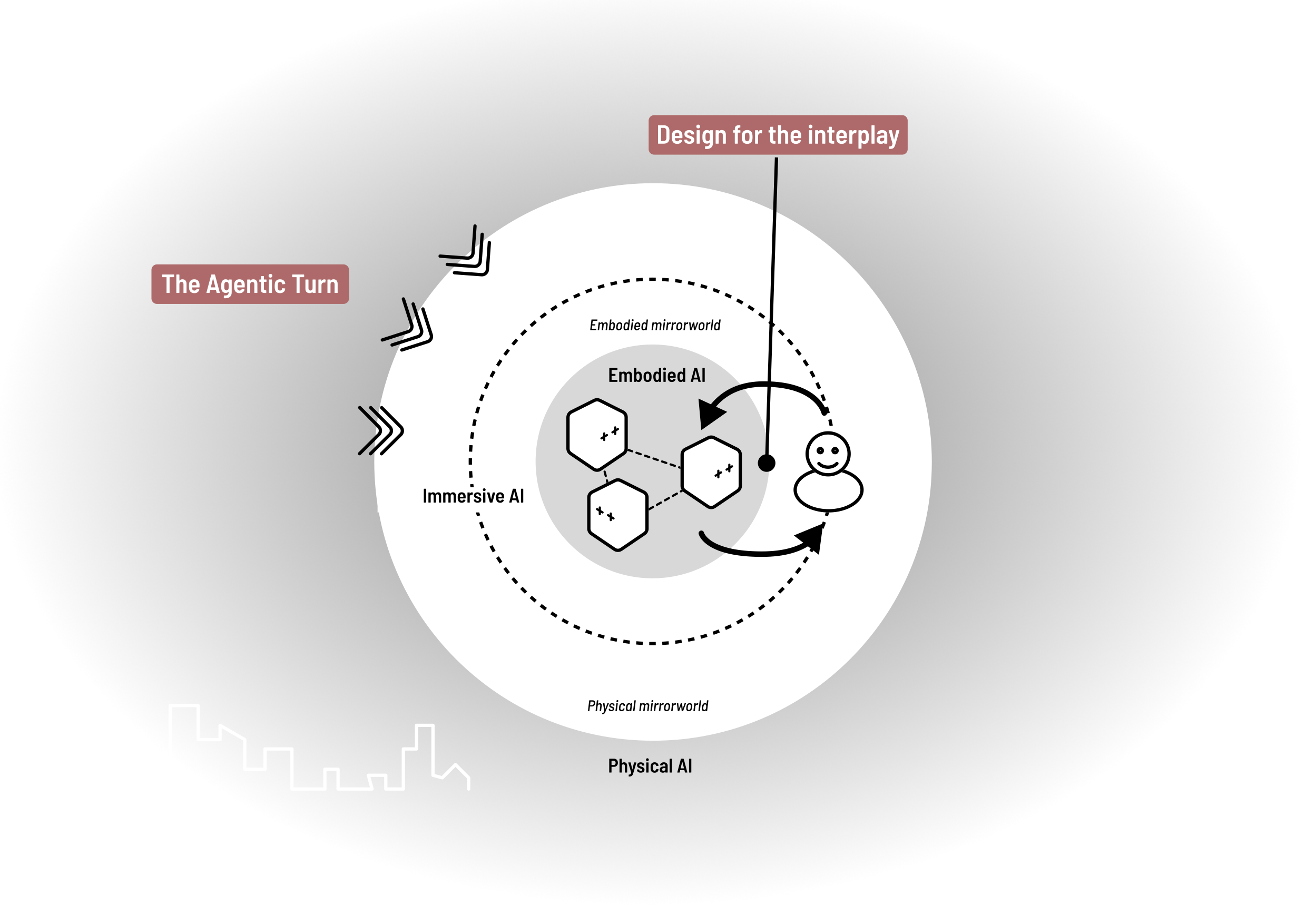
AI is leaving the screen and entering the room. Buildings that learn how their residents move. Delivery carts that know the neighborhood. Energy systems that coordinate across a city block without being asked. Mesh networks where devices reason locally and act collectively. Physical AI adds situational awareness as the final crucial component to complete the digital transition.
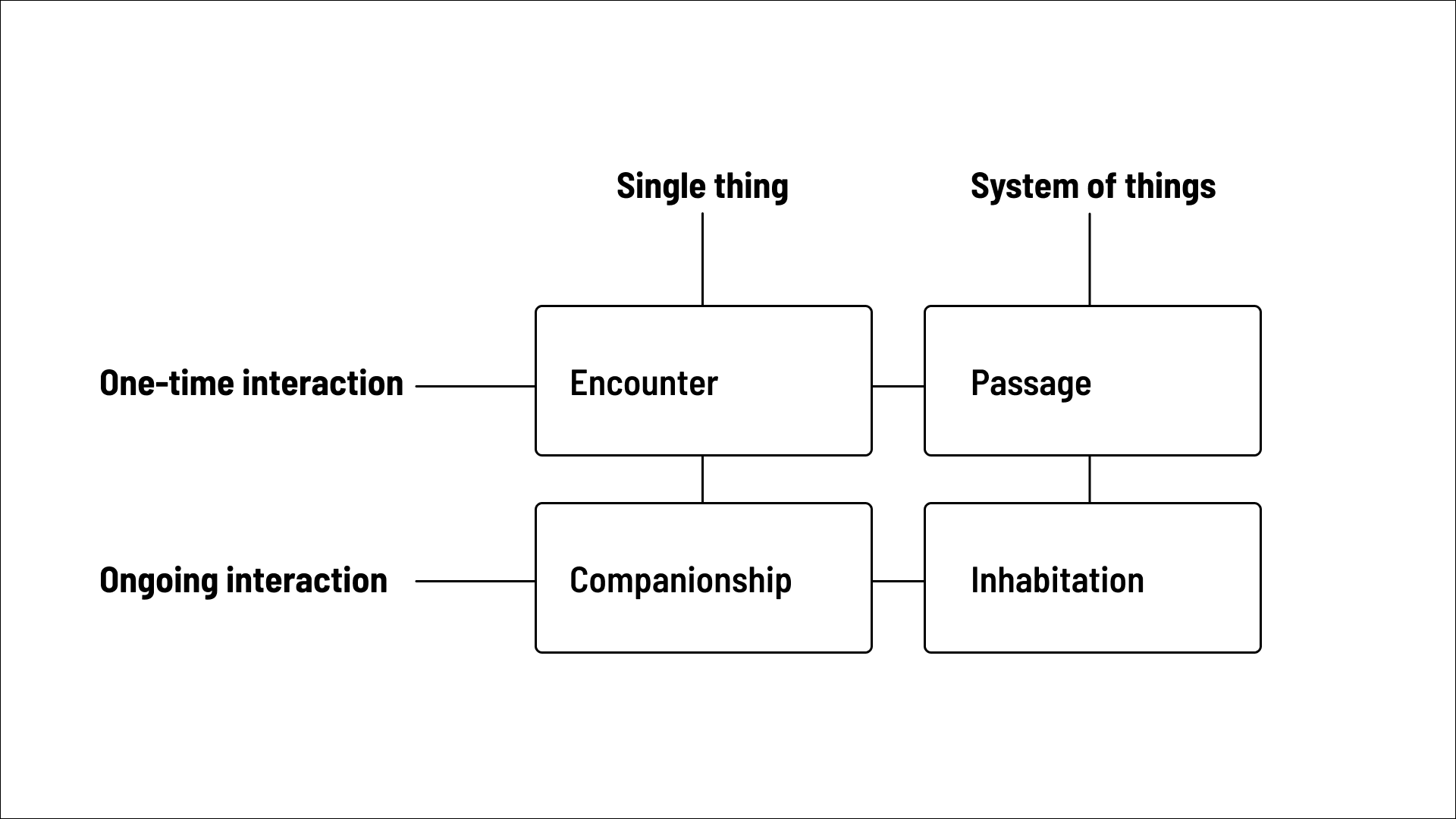
This creates entirely new design possibilities. Products that combine intelligence with location. Services that adapt over time through genuine relationships with people. Environments where the interplay between human and thing becomes the core experience. The organizations that learn to design for these possibilities first will define the categories that follow.
This is the domain of immersive AI; the condition of living and working inside intelligence, rather than visiting it on a screen. It offers new affordances for designing products and services.
The Impact of Immersive AI
When AI becomes an environmental condition, distributed across things, spaces, and infrastructure, it opens up new design territory.
Products that sense and respond to context. Not smart devices reporting to a cloud, but things that reason where they are. A cleaning unit that notices something in the soil sensors and pauses to investigate. An energy hub that forms a position before the community meeting. When edge AI gives things their own local intelligence, products become participants rather than instruments.
Services that grow through relationship. A delivery cart that learns your household rhythm over three years and adjusts without being told. A building system that earns trust through months of subtle coordination. Immersive AI enables services where depth is built through interaction, not imported from a dataset, and where that relational quality becomes the competitive advantage.
Environments that coordinate as assemblages. Not a single smart system, but dozens of things — energy, logistics, maintenance, communication — that share what they have learned and adapt together. The refrigerator talks to the composting system. The irrigation negotiates with the energy cooperative. New combinations emerge that no single product team imagined.
New infrastructure for community coordination. Mesh networks, shared protocols, neighborhood-level governance for autonomous things. The technical possibility already exists for communities to build their own intelligent infrastructure — cooperative, open-source, locally controlled.
These are not speculative claims. They are design possibilities grounded in seven years of research, prototyping, and expert consultation at Cities of Things, synthesized in the 2026 Manifesto for Immersive AI.
Is This Relevant to Your Work?
Immersive AI is not a single domain — it surfaces wherever intelligence meets physical space. Here are some entry points:
You are developing energy products or grid services, and wondering what happens when distributed systems start coordinating autonomously, forming positions before stakeholders convene. How do you design for community energy cooperation, not just individual optimization? What does a neighborhood-scale energy commons look like in practice?
You are working in mobility, logistics, or autonomous systems, and facing the gap between what the technology can do and what cities and communities will accept. How do you build trust over time? How do you navigate governance requirements before they become regulation? What can seven years of street-level prototyping with neighborhood robots teach your deployment strategy?
You are designing buildings, housing, or spatial environments, and sensing that the intelligence layer is about to change what architecture means. Buildings are becoming participants, not containers. How do you design for the interplay between spatial experience and distributed intelligence? What happens when a building's systems form relationships with each other — and with the people inside?
You are developing health or care services, and navigating the tension between ambient intelligence that supports and surveillance that controls. How do you design for dignity? Where is the line between a system that anticipates needs and one that removes autonomy?
You are shaping public space or civic infrastructure, and are aware that digital systems are arriving in the streetscape without the democratic processes that physical infrastructure requires. How do you create governance before deployment? What does citizen sovereignty over intelligent infrastructure actually look like?
You are a design team, innovation lab, or strategy department, and physical AI, agentic AI, or immersive AI is on your horizon but not yet in your practice. You need someone who has spent years mapping this territory and can help you navigate it with both ambition and critical awareness.
Conditions of Interplay
Check also our new Manifesto for Immersive AI.
History Cities of Things
In 2017 Iskander Smit was invited to take the role of Design United visiting professor at Delft University of Technology, Faculty Industrial Design Engineering, next to his role as innovation director of INFO. As visiting professor Iskander worked closely together with prof. Elisa Giaccardi and the Connected Everyday Lab. As a new research program PACT was initiated (Partnerships in Cities of Things). The first result was a postdoc research program in collaboration with AMS Institute, performed by Maria Luce Lupetti and Nazli Cila (part-time). Two master graduation projects started to research Things as Citizens (Louise Hugen) and Hidden Civic Futures (Sen Lin). That was a good moment to establish a so-called Delft Design Lab themed Cities of Things, to build knowledge through the commissioning of master graduation projects. Maria Luce and Nazli completed the post-doc with a conference paper on near future cities of things, and a workshop format, later accompanied by a conference paper.
In the beginning of 2018 the Delft Design Lab was established with founding industry partner INFO that funded the in-kind coordination hours of the lab director. Multiple graduation students did projects for the lab research or in collaboration with one of our partners Advier, AMS, WAAG and INFO. Next to master graduation projects specific research and educational projects connected to cities of things were initiated.
Beginning 2020 the Creative Embassy AMS-MUC - a partnership between the cities of Amsterdam and Munich - invited Cities of Things to set up a field lab to connect industry partners from the two cities. A consortium of now 9 Dutch creative companies is now involved together with the Munich Urban Colab as partners. Due to Corona, the official launch was postponed to the last quarter of 2021.
In 2021 Cities of Things started building another field lab in Rotterdam together with Creating010 of Rotterdam University of Applied Sciences and Rotterdam creative industries, projected to start in 2022. Cities of Things is established as a foundation to bring even more focus in the making the connection of research and practice around the theme of cities of things.
The core theme of the research goal is the notion that we more and more will live together with intelligent things, and relate to intelligent systems. In our research, we have a focus on the design of these new relationships and interactions.