The 2026 Manifesto
The new design possibilities of immersive AI are real, but so are the risks. Intelligence that enters the room can enrich experience or silently erode agency. It can strengthen communities or fragment them. The difference is in the design.
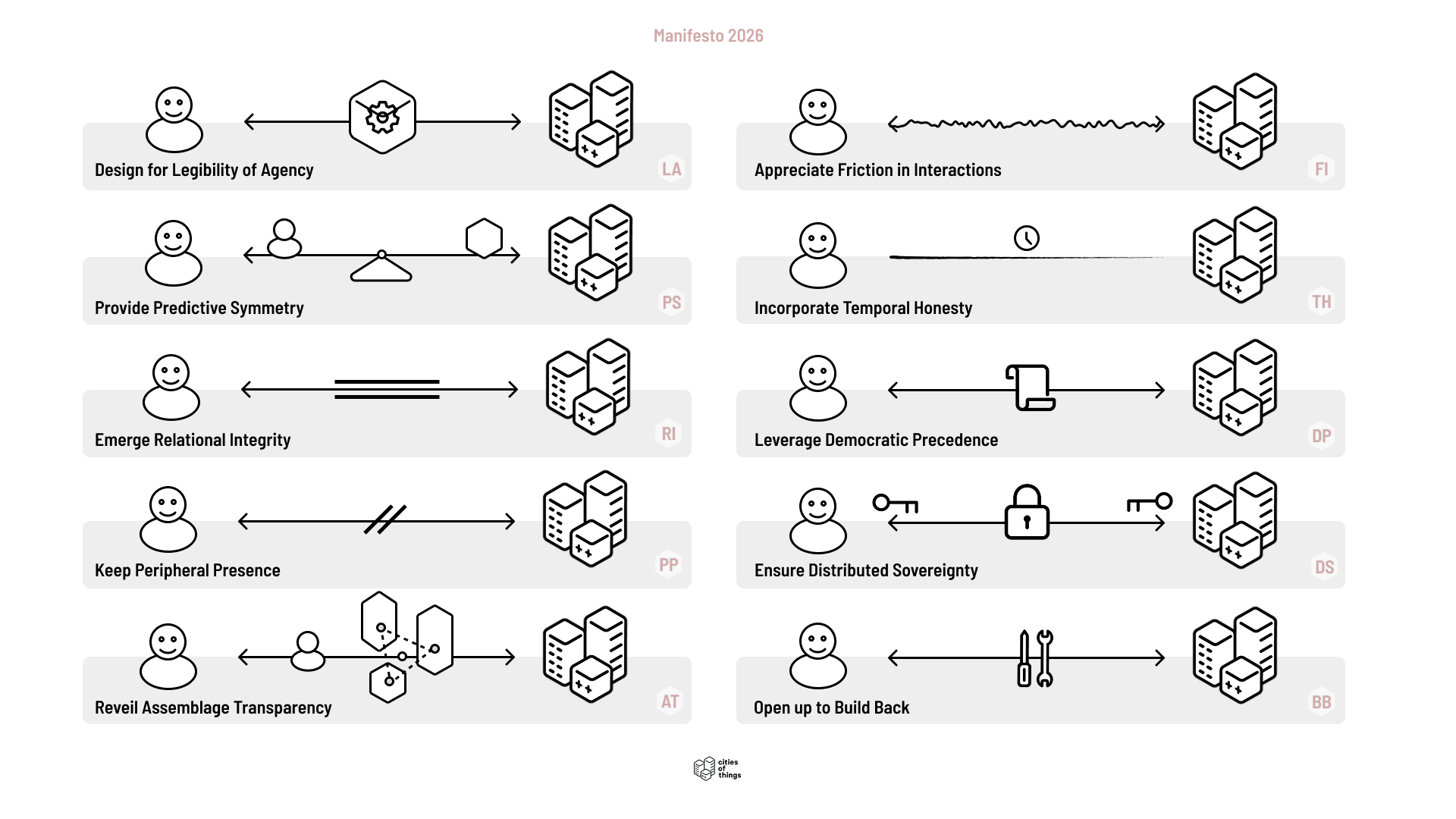
The 2026 Manifesto for Immersive AI provides ten considerations for designing responsibly and effectively in this space, developed through conversations with more than 30 leading experts across design research, urban policy, robotics, architecture, and technology strategy, combined with seven years of applied research.
- Design Legibility of Agency — When a thing acts, people should be able to understand that it acted, why, and on whose behalf.
- Provide Predictive Symmetry — When a system predicts a person, that person should have meaningful access to the nature and basis of the prediction.
- Emerge Relational Integrity — The quality of a human-thing relationship should emerge from interaction itself, not be predetermined by external optimization.
- Keep Peripheral Presence — Agentic intelligence should operate at the edge of attention, not the center.
- Reveil Assemblage Transparency — When things coordinate around a person, the fact and scope of that coordination should be perceptible.
- Appreciate Friction in Interactions — People must retain access to resistance, surprise, and unoptimized experience.
- Incorporate Temporal Honesty — Systems should not simulate relational depth they have not earned.
- Leverage Democratic Precedence — Communities define the environment they want before agentic systems are introduced.
- Ensure Distributed Sovereignty — Data, models, and infrastructure should be subject to collective governance.
- Open up Build Back — People must be able to introduce their own things, modify assemblages, and keep technological possibility open.
These considerations are not constraints on innovation. They are what makes the difference between products people tolerate and products people trust.
Find more description about the ten considerations here.